
Bring Planning Intelligence into the Business
Software You Build
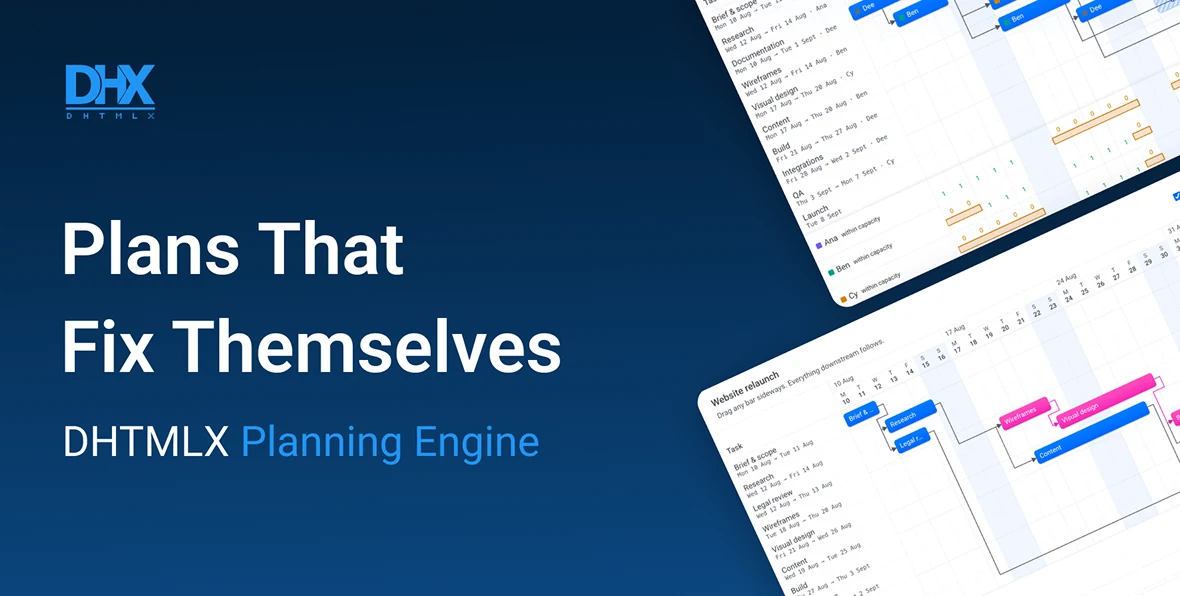
Meet DHTMLX Planning Engine, an embeddable scheduling engine that puts resource-aware planning with on-demand leveling right into your product.


Claim Advanced Resource Planning
as Your Product Feature
we have when some are busy and certain
tasks can't move?
For your users, limited resources often create a tangled web of commitments that standard planning tools cannot unravel. DHTMLX Planning Engine can.
With dependencies, constraints, and priorities modeled around real project structures, it calculates schedules and workloads with precision and offers resource leveling, empowering users to:
DHTMLX Planning Engine Core Capabilities
Automatic Scheduling & Recalculation
One task moves, the plan follows. DHTMLX Planning Engine schedules forward or backward and recalculates affected tasks accounting for:
Resource Overload Detection & Leveling
The engine distinguishes between "correctly calculated dates" and "work that can actually be performed with available resources," helping users:
Explainable Plan Diagnostics
DHTMLX Planning Engine returns structured diagnostics on dependency cycles, constraint violations, missed deadlines, and resource overloads, with explanations of unresolved conflicts. Turn these findings into alerts, dashboards, reports, and notifications that help users understand what puts their plan at risk and why.

Fast for Live Planning, Built for Dates Users Can Trust
Consistent results
Deterministic scheduling and leveling, with the same scheduling model in browser and server deployments.
Fast recalculations
In resident mode, a prepared in-memory model and incremental updates reduce repeated calculation work.
Responsive behavior
Browser-side calculations avoid server round trips; optional workers keep calculations off the UI thread.
on a 10,000-task plan
Consistent across Environments
Your screens
DHTMLX Gantt · Grids · Boards ·
Calendars · Mobile
DHTMLX Planning Engine
Scheduling · Leveling · What if
Your backend
APIs · Services · Background jobs
Integration on Your Terms
Your choice of UI
Connect scheduling calculations to DHTMLX Gantt, grids, boards, calendars, or a custom interface.
Plain data in and out
Pass a JSON snapshot and receive changed dates, planning diagnostics, and requested analytics.
Your app stays in control
Keep your UI, data, and workflows. No hosted service or separate scheduling database required.
Fits your stack
An embeddable resource scheduling library with Rust, TypeScript, .NET, and Java APIs, plus WASM deployment.
Build Resource Planning Tools for Your Industry

Construction & engineering
Scheduling construction phases around crew availability, equipment capacity, and site calendars; assessing how delays affect handover dates.

Manufacturing
Calculating completion dates for production orders, sequencing work across machines and shifts, and leveling eligible operations to reduce overloads.

Field service & maintenance
Scheduling repair and preventive maintenance within service or shutdown windows, accounting for technician availability and shared equipment capacity.

Agencies, consulting, & PSA
Planning staff workloads around client milestones and bookings, analyzing utilization, and identifying over-allocation.

ERP & CRM
Returning realistic promise dates for quotes and orders, automatically recalculating them after order changes, and flagging deadline risks and scheduling conflicts.

IT & product development
Planning release tasks around shared specialist availability, leveling competing work, and assessing the impact of delays on release milestones.
Request DHTMLX Planning Engine Pricing
Frequently Asked Questions
DHTMLX Planning Engine is a headless scheduling engine that can be integrated with DHTMLX Gantt or a custom UI. It returns scheduling results and diagnostics for your application to display, while your application controls the interface, data storage, and workflows.
DHTMLX Gantt combines an interactive planning UI with built-in scheduling features, including dependencies, working calendars, and date constraints. DHTMLX Planning Engine extends these capabilities with resource capacity analysis, on-demand leveling, independent what-if scenarios, and structured planning diagnostics. Unlike Gantt, it has no built-in UI: your application presents the results and controls how changes are applied.
DHTMLX Planning Engine compares resource demand with available capacity over working time. On request, it runs deterministic heuristic leveling to delay, resequence, pause, or split eligible work according to configured priorities, locks, dependencies, calendars, and deadline rules. If an overload cannot be resolved within those rules, it returns the remaining conflict and its cause. Your application decides which changes to apply.
Yes, DHTMLX Planning Engine provides Rust, TypeScript, .NET, and Java APIs for building resource scheduling tools. Its TypeScript implementation runs in browsers and on the server via Node.js, producing the same results for the same inputs, configuration, and engine version.
DHTMLX Planning Engine returns calculated dates and schedule changes, feasibility status, conflicts, warnings, and requested analytics such as slack, critical-path data, and resource overloads. Leveling results include unresolved overloads and their causes. Scenario calculations provide dates, deadline risks, and overloads for comparing alternatives. Your application controls how results are displayed, applied, and saved.