
Updated on June 16, 2026
UPD: If you’re searching for a free alternative to DHTMLX Gantt, let’s be honest: you won’t find anything close in terms of features. But the good news is that the DHTMLX Gantt is now available under the MIT license in the Community Edition. You can start using it for free in any project, including commercial, and migrate to the PRO whenever you need advanced features with no code changes.
The landscape of open-source JavaScript Gantt chart libraries hasn’t changed much in recent years. Until now, the choice has been limited to a few tools, including Frappe Gantt, jsGanttImproved, and Twproject Gantt. But this shortage of choice is only half the trouble.
For development teams, the task of getting the right open-source Gantt becomes even more complicated when it comes to meeting modern project requirements. It is rare to find a tool that lives up to the expectations in feature coverage, performance, documentation quality, tech support, and frequency of updates.
That is why we decided to give a helping hand to the development community and included the new DHTMLX Gantt Community Edition available under the MIT license in our recent Gantt 10.0 release. It is not just a new option for consideration, but a time-proven product that should dispel well-known concerns associated with the use of open-source tools.
In this blog post, we’ll compare our new MIT-licensed Gantt Chart Library with other open-source Gantt libraries, see how they address the needs of dev teams, and discuss potential pitfalls of using free UI components.
Why Developers Look for Free Gantt Chart Libraries
Implementing a Gantt chart into a modern project management app often demands non-trivial engineering solutions within a tight development schedule. However, not every business can afford to invest in established commercial Gantt libraries at the very start of the project.
That is why many startups and SMBs prefer to start their search on GitHub. Open-source Gantts do not impose any upfront licensing fees, and their codebases are freely available for any modifications.
Apart from reasonable expectations of cost reductions, open source UI components offer some other significant benefits. First of all, we have to point out the vital role of the community in collective problem-solving, transparency, and continuous improvement of open source projects. Developers have the freedom to enrich any open source tool with missing features or fix issues independently. So it is not surprising that the respondents of the Developer Survey 2025 name GitHub the most admired community platform, and developers without prior experience with GitHub want to work with GitHub public repos in the coming year.
Taking into account all these benefits of open source tools, it is clear why developers may consider the possibility of looking for DHTMLX alternatives on GitHub or other open source platforms. Let us specifically review some open source project management tools that may be seen as viable options for replacing DHTMLX in a web project.
Popular Free Open-Source DHTMLX Gantt Alternatives for Project Management
DHTMLX Gantt Community Edition
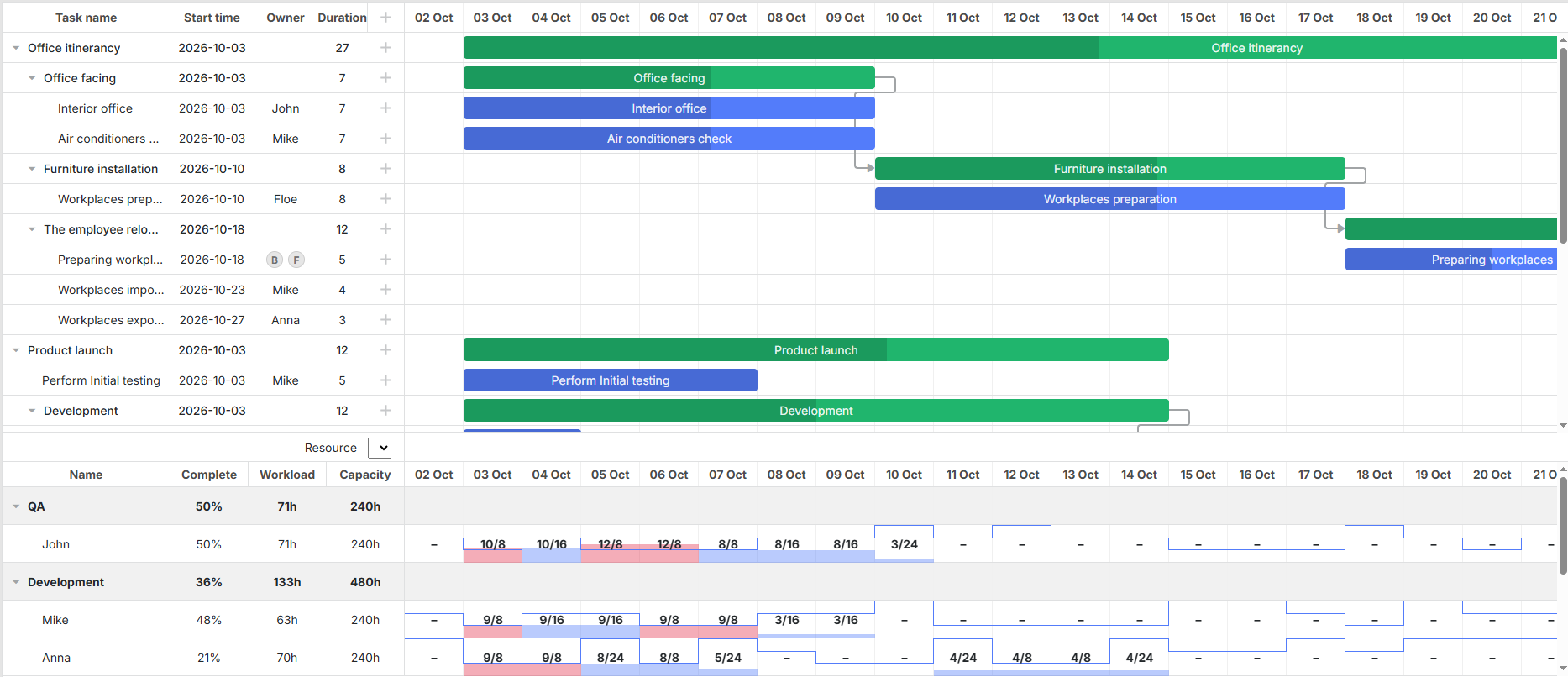
DHTMLX Gantt Community Edition is now available under the MIT license, which allows use, modification, and distribution for both open-source and commercial projects.
This free Gantt option embraces the core benefits of the recognized DHTMLX Gantt. Here, you get a solid feature set for planning and managing workflows, except for the advanced features available in the PRO edition (side-by-side Community vs PRO comparison). The comprehensive and well-organized documentation gives a clear idea of how and when to use specific Gantt capabilities. Numerous integration guides, code snippets, and live samples help further simplify the integration process and any required adjustments. If any tricky issues arise, it is possible to ask for assistance on the DHTMLX community forum.
If your project grows and requires advanced features like resource management, critical path, or auto-scheduling, upgrading to the DHTMLX Gantt PRO edition will take minutes.
Are there any open source project management tools like that? Let’s find out by reviewing a couple of curious options.
Frappe Gantt
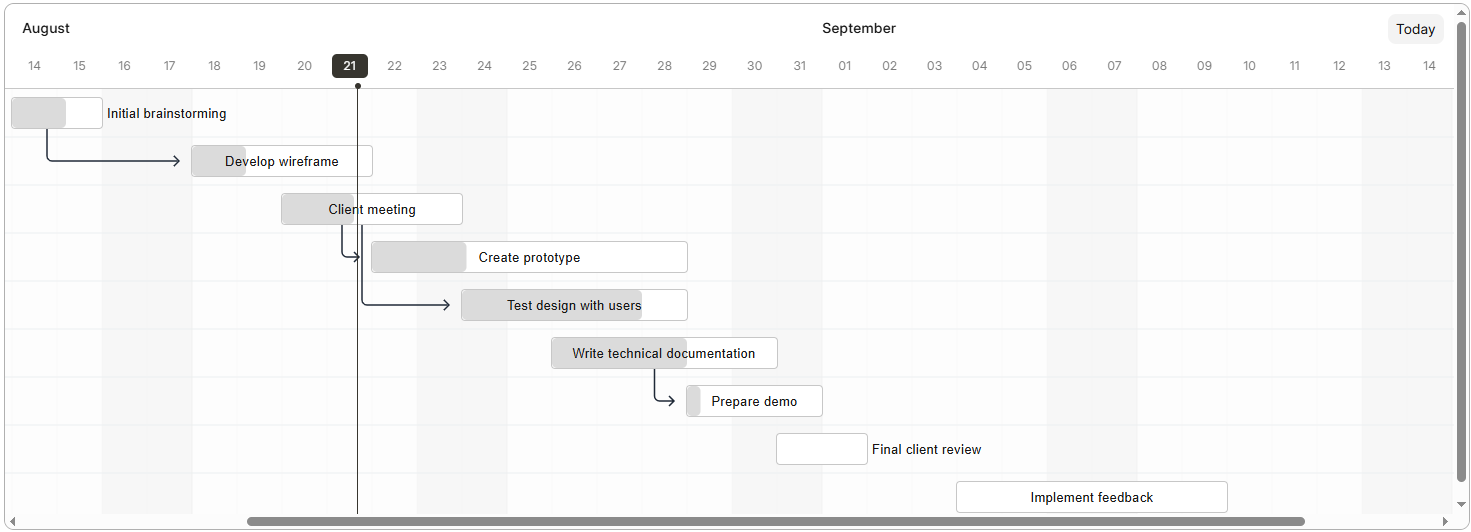
It is probably the most well-known open source Gantt chart solution on the web. This lightweight, dependency-free Gantt library is suitable for integrating a basic Gantt chart in small apps or prototypes. Frappe Gantt provides drag-and-drop interactivity, task dependencies, flexible timelines, configurable popups, weekend/holiday marks, and multi-lingual support. It also relies on HTML5 and SVG rendering, ensuring crisp visuals and basic customizations with CSS. Frappe Gantt originated from the need to add a Gantt view to ERPNext, a 100% open-source enterprise resource planning solution developed by the Frappe team. Interestingly, the GitHub page of the project states that DHTMLX Gantt served as an inspiration for the initial product design.
jsGanttImproved
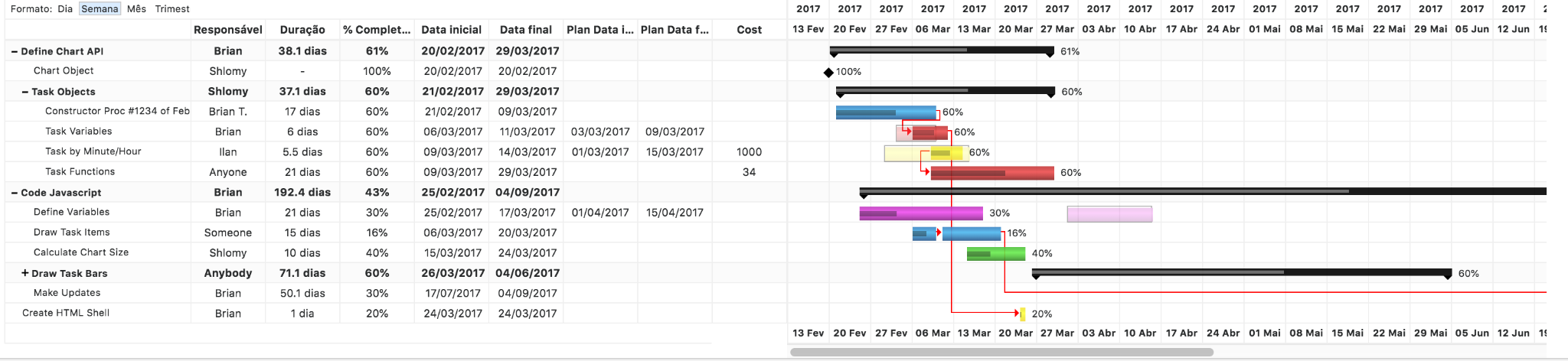
Built upon the original jsGantt project, this free frontend library extends the capabilities of its predecessor with extra features and bug fixes. It seems like a workable solution for delivering a classic Gantt experience with basic task scheduling and dependency visualization. Here you can find essential Gantt features such as task dependencies, progress tracking, milestones, resources, and task styling. On top of that, this Gantt library supports dynamic loading of tasks, dynamic change of time format, data import/export in XML, and internationalization. jsGanttImproved also comes with wrappers for integrating the Gantt library into projects based on popular JS frameworks (React, Angular, Vue, .NET).
Twproject Gantt
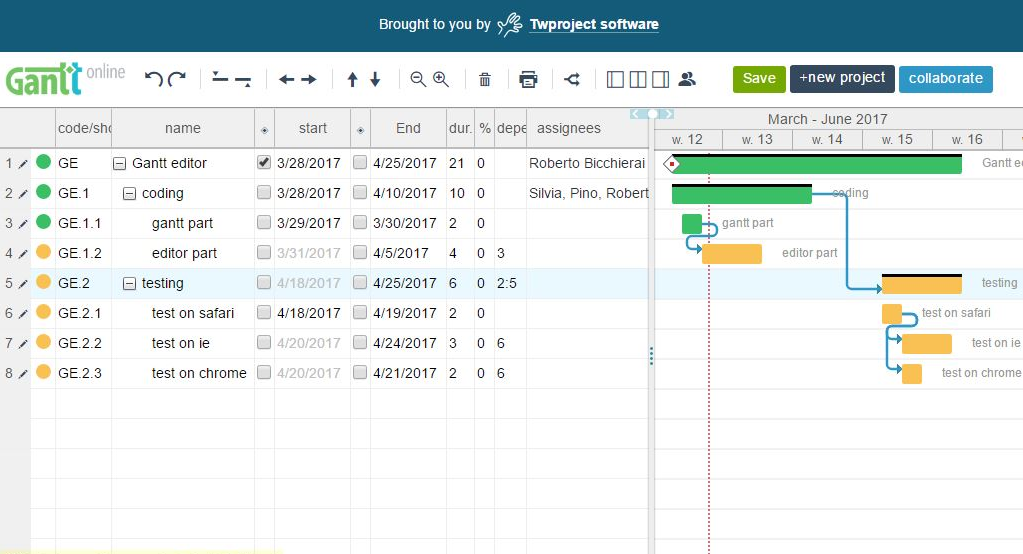
Originally part of the Twproject solution for project management, this free online jQuery-based Gantt editor can be used for handling projects with more than just basic needs. Most of the standard Gantt capabilities, like drag-and-drop support, dependencies, task editing, milestones, and undo/redo operations, are in place. It also allows solving more challenging tasks such as resource and workload management, critical path prioritization, and exporting/ printing of project data. This Gantt is a functional, standalone editor that can be used in web browsers. At the same time, it belongs to the Twproject ecosystem, making it more complicated to embed this open source Gantt chart into a custom app.
The Upgrade Path Problem
Not all open-source Gantt libraries are regularly updated with new features and integration options. Therefore, they are commonly good for prototypes, MVPs, and lightweight use cases. But when it is time to take steps on further project expansion, teams often start experiencing functional limitations. At this point, they have to make a difficult choice: maintain custom forks, implement missing features by themselves, or migrate to another library.
When choosing DHTMLX Gantt Community Edition, all these difficulties can be avoided. The MIT-licensed Gantt covers the common project management needs at early stages. The seamless transition to the PRO edition unlocks enterprise-level features while keeping the same API, architecture, and project code.
For clarity, let us review the tools described above in a tabular format:
| Criteria | DHTMLX Gantt | Frappe Gantt | jsGanttImproved | Twproject Gantt |
| License | MIT/Commercial | MIT | MIT | MIT |
| Feature set | Rich | Basic | Basic | Decent |
| Performance | High (handles 30k+ tasks efficiently, enterprise-ready) | Fast enough for small datasets | Moderate (for small to medium datasets) | Decent (for small to medium datasets) |
| Customization
/Styling |
Extensive (built-in themes, templates, custom HTML, CSS) | Basic (via CSS) | Basic (via CSS) | Limited CSS styling |
| Documentation coverage | Comprehensive ( guides, tutorials, video, API reference | Minimal (README on GitHub) + tutorials on the web | Basic documentation on GitHub | Usage instructions, video tutorial, Twproject blog |
| Samples/Demos | 1000+ code samples and demos | Several live samples + examples on CodeSandbox | A couple of live examples | Online demo |
| Tech support | Community/Professional support team | Community only | Community only | Backed by the Twproject team + community |
| Integration with frameworks and backend technologies | Framework-friendly+works with popular backends | Wrappers for popular frameworks | Wrappers for popular frameworks | May require a lot of customization |
| Best use case | Enterprise-grade project management apps | Demos, prototypes, small apps | Internal tools, educational projects, and apps that need a moderately equipped Gantt chart | Delivering well-packed Gantt charts in web browsers |
| Upgrade path | Community Edition → PRO: seamless, no code changes | No | No | No |
Summarizing the open-source Gantt charts comparison above, it is obvious that the reviewed tools can be considered as alternatives to the DHTMLX Gantt only in very limited scenarios (demos, prototypes, or small apps). For enterprise-level apps, where dev teams rely on JavaScript components to solve many challenging tasks, the DHTMLX Gantt chart component remains a more preferable option.
Chances are, you will see a similar picture when considering open source alternatives for other DHTMLX components. For instance, you may try to find the best free DHTMLX alternatives for scheduling, but our JavaScript scheduler library is likely to be a preferable option too.
Potential Hidden Costs of Open-Source UI Components
Now, we want to delve deeper and highlight why free Gantt charts may cost you more than commercial ones in the long run:
- Less expensive but more time-consuming
At first, open-source project management tools may be a preferable option in terms of financial costs. However, as it is said, time is money, and this is especially true in the context of web development. Extra resources required for properly testing, securing, customizing, and integrating are frequently ignored at the preparation stage. As a result, the development lifecycle becomes more complex, extending time-to-market and driving up costs.
- Documentation
Open-source UI components often come with shallow or incomplete documentation, covering basic usage scenarios and configuration options. In open-source projects, tutorials and other useful materials often result from irregular community contributions. With Gantt charts, developers have to properly arrange intricate layers of data, dependencies, and timelines. Insufficient reference information leads to integration obstacles.
- Licensing peculiarities
Another popular misconception about open source UI components is that they come under licenses that do not impose any restrictions. However, you may also face licensing issues with open source. There are some licenses called permissive, such as MIT, Apache, and BSD, and they impose minimal restrictions on how given tools are used, modified, and distributed. At the same time, open source products may also be distributed under copyleft licenses (GPL, LGPL, MPL) that aim to preserve the open source nature of the software. It means that when such a tool is modified and distributed as a part of a web project, it should be licensed under the same terms, i.e., it must be open and available to others without charging a licensing fee. Otherwise, it is very likely to face legal risks of non-compliant usage in closed-source apps.
- Support and maintenance
Many open-source Gantt chart libraries for project management rely on volunteers and maintainers who contribute in their spare time. While community support can be effective, response times and issue prioritization are naturally less predictable than with commercially backed products. It is a common practice for maintainers of open source projects to sell tech support and maintenance services as add-ons. It can also not be ruled out that at some point, such products may slow down or even stop growing if maintainers lose interest or funding.
- Scalability & Performance
When looking for a worthy DHTMLX Gantt open source alternative, it is necessary to make sure that the considered open source tools are enterprise-ready in such vital criteria as performance and scalability. This may turn out to be disappointing since many open source tools struggle to meet enterprise-level demands like processing large datasets, handling increasing workloads, and integrating with complex backend systems.
- Security concerns
And last but not least, we have to mention possible security risks in open-source JavaScript project management components. The code of such tools is publicly available, increasing the chances that security issues will be detected and fixed by the community. But not every open source product has an active and dedicated community. Apart from that, this kind of transparency can also be used by attackers to insert malicious code into the package. All in all, open source tools turn out to be less predictable in terms of security than commercial ones.
Indeed, the use of open-source Gantt components can be associated with numerous pitfalls that are not apparent straight away. But it does not mean that teams should give up on open-source tools. When established industry players make their mature products publicly available, most of the risks described above are reduced to a minimum.
Conclusion
The new DHTMLX Gantt Community Edition is the best and free alternative to DHTMLX Gantt and a great addition to the open-source ecosystem. It provides all you need for launching a project management app and not worrying about potential risks and uncertainties that are typical for free tools. It supports comprehensive drag-and-drop behavior, several types of task dependencies, milestones, project summary, and many other useful features. But most importantly, it provides a flexible path for extending the Gantt project with powerful features and ensuring professional technical support by migrating to the PRO Edition as your business grows. Here is the GitHub repository dedicated to the Community Edition, where you can learn more details about the MIT-licensed Gantt and how to get started with it.