
Previously, we shared our path to building a Gantt-based planning app with Lovable AI via structured prompting. It helped us demonstrate that Lovable can reliably handle complex project workflows with interdependent tasks when guided by clear architectural rules and constraints. But what if your React project requires a different kind of planning system focused on timeline-based booking and resource management? This functionality can be implemented using our React scheduling component, which aligns well with the AI-powered development workflow we used for the Gantt project.
In this blog post, we present a Lovable-based full-stack scheduling solution built with Supabase as the backend layer, DHTMLX React Scheduler, and other popular technologies.
What Makes the Scheduler Starter Different
Although both Gantt and Scheduler starter projects in Lovable AI share many similarities in project architecture, technology stack, and development workflow, they follow completely different planning models.
While the Gantt demo focuses on optimizing the project execution flow, the React Scheduler Lovable starter demo is more about effective availability management and time allocation when booking resources.
To reflect this difference in our project, we needed to accurately specify a range of Scheduler-specific capabilities via prompts and explicit rules, including:
- Advanced handling of recurring bookings with support for custom recurring series
- Conflict detection of overlapping bookings, preventing invalid time-slot allocations
- Location-partitioned resources and bookings organization
- Business hours awareness control with visual highlights and warnings
Open the live demo to try all these features in action.
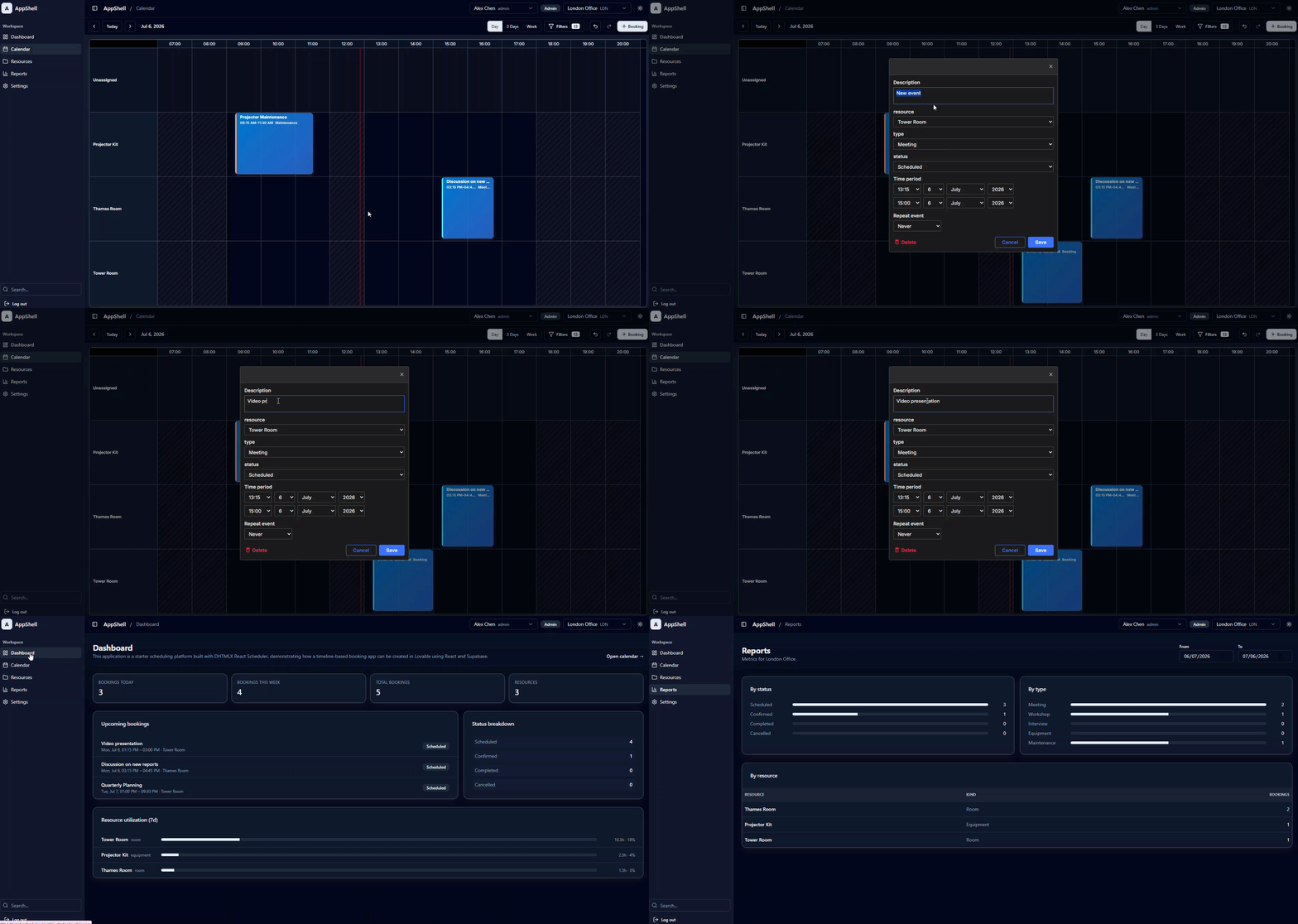
It proves once again that with the right approach, Lovable AI is capable not only of generating code for common UI elements and CRUD operations but also of smoothly integrating enterprise-grade components like DHTMLX React Scheduler.
What to Do Next?
Now that you’ve seen what the React Scheduler Lovable Starter can do, the next step is translating the theoretical value of this project into practice. From here, you can use the starter in two main directions.
Master the Implementation of Complex UIs
The Lovable AI platform has gained unprecedented popularity by providing a simple way to transform bold ideas into fully functional applications using natural language prompts. However, many teams struggle to integrate advanced third-party UI libraries into their AI-powered workflows. That’s where our Scheduler starter can serve as a handy practical guide on the subject. It includes the complete set of prompts required to reproduce the project from scratch, while learning all the peculiarities of the integration process and fixes we had to make along the way.
Turn The Starter into a Full-Stack Scheduling App
The React Scheduler Lovable Starter goes beyond a typical proof-of-concept project by providing a fully structured, backend-connected foundation for delivering production-oriented scheduling systems. If you like the starter’s general idea, you are free to clone the published repository, connect your Supabase backend, and modify the initial logic to meet specific scheduling needs.
No matter which path you choose, it will be useful to explore with the following materials:
- Scheduler Lovable Starter Walkthrough
- DHTMLX React Scheduler Documentation
- DHTMLX MCP Server
- DHTMLX Agent Skills
- Building a Full-Stack React App in Lovable AI with DHTMLX Gantt
Keep on learning and continue your AI-assisted app development journey with DHTMLX.