
When working on the release of DHTMLX Gantt 10.0, we thought hard about how to make the anniversary edition of our JavaScript Gantt component special not only for DHTMLX users but also for the entire development community. This release delivers a fully refactored scheduling engine that resolves most of known issues in the scheduling algorithm, bringing popular features like auto-scheduling and critical path to another level. In addition, we also introduce the new zoom-to-fit feature for simplified navigation in large projects, and officially present stable versions of Angular and Vue wrappers, meaning they are ready for use in production environments.
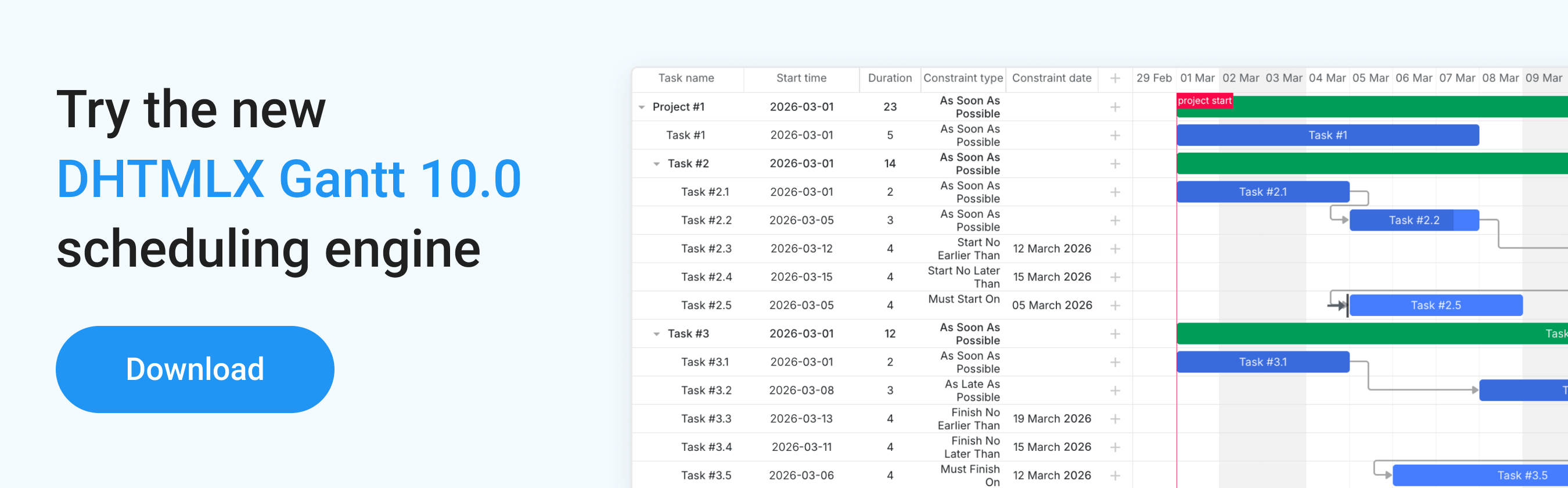
Alongside v10.0, we are releasing the Community edition of DHTMLX Gantt under the MIT license, making that edition a more attractive option for a wider range of use cases.
New Scheduling Engine
The most notable functional novelty delivered in v10.0 is a major transformation of the built-in Gantt scheduling engine. We deeply refactored and eliminated many known issues, mostly associated with calculations of slack times and project tasks (also known as summary tasks). As a result, the engine offers a new, more reliable way for processing working calendars, task dependencies, and constraints to dynamically power the key PRO features for DHTMLX Gantt: auto-scheduling and critical path. Teams who have previously used these features in their apps will certainly notice a smoother scheduling experience.
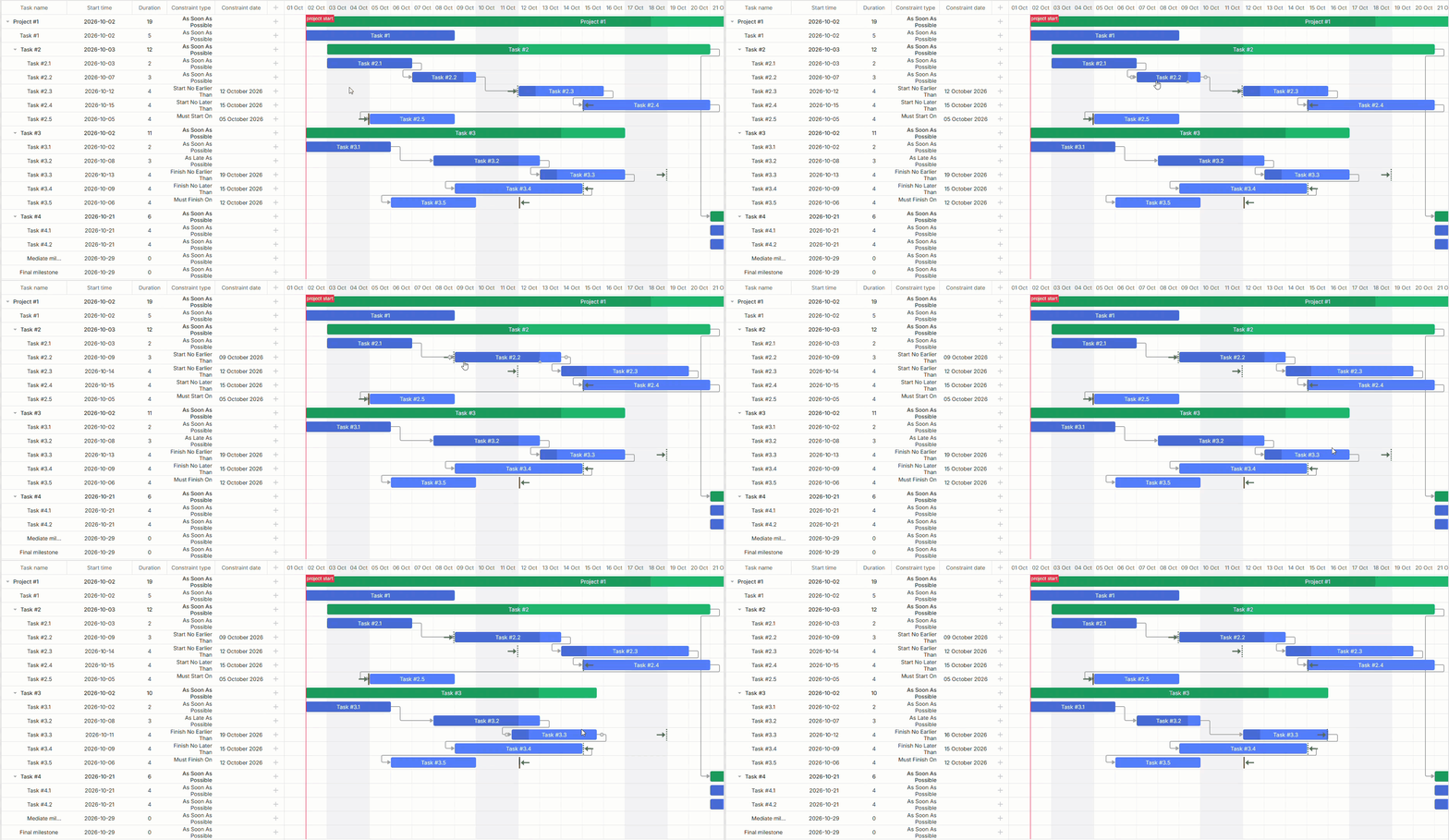
From the technical standpoint, you won’t have to deal with any breaking changes. The public API remains unchanged. The auto-scheduling algorithm uses the same settings and operating patterns, but with enhanced reliability and superior accuracy. More details on positive changes in auto-scheduling are provided in the documentation.
The renewed scheduling engine can be used in both frontend (in web browsers) and backend (via the Node.js server module) environments, ensuring the same high-performance scheduling across all deployment scenarios. More details on the auto-scheduling engine update are available in the documentation.
Built-in Zoom-to-Fit
Building Gantt charts for handling complex projects with thousands of tasks is not an issue with DHTMLX. But it is also important to ensure maximum usability for end users (project managers, stakeholders, etc.) when navigating charts of this scale. For a better user experience in such scenarios, v10.0 comes with the built-in zoom-to-fit feature.
Similar behavior could previously be enabled with custom code based on the Zoom extension. Now, it can be added simply by calling gantt.ext.zoom.zoomToFit(), which sets the maximally detailed zoom level to show the entire project workflow without scrolling. Returning to the previous scale is achieved with gantt.ext.zoom.resetZoom(). It helps reduce the amount of boilerplate code, simplify long-term maintenance, and standardize the way to apply this zoom feature in Gantt charts.
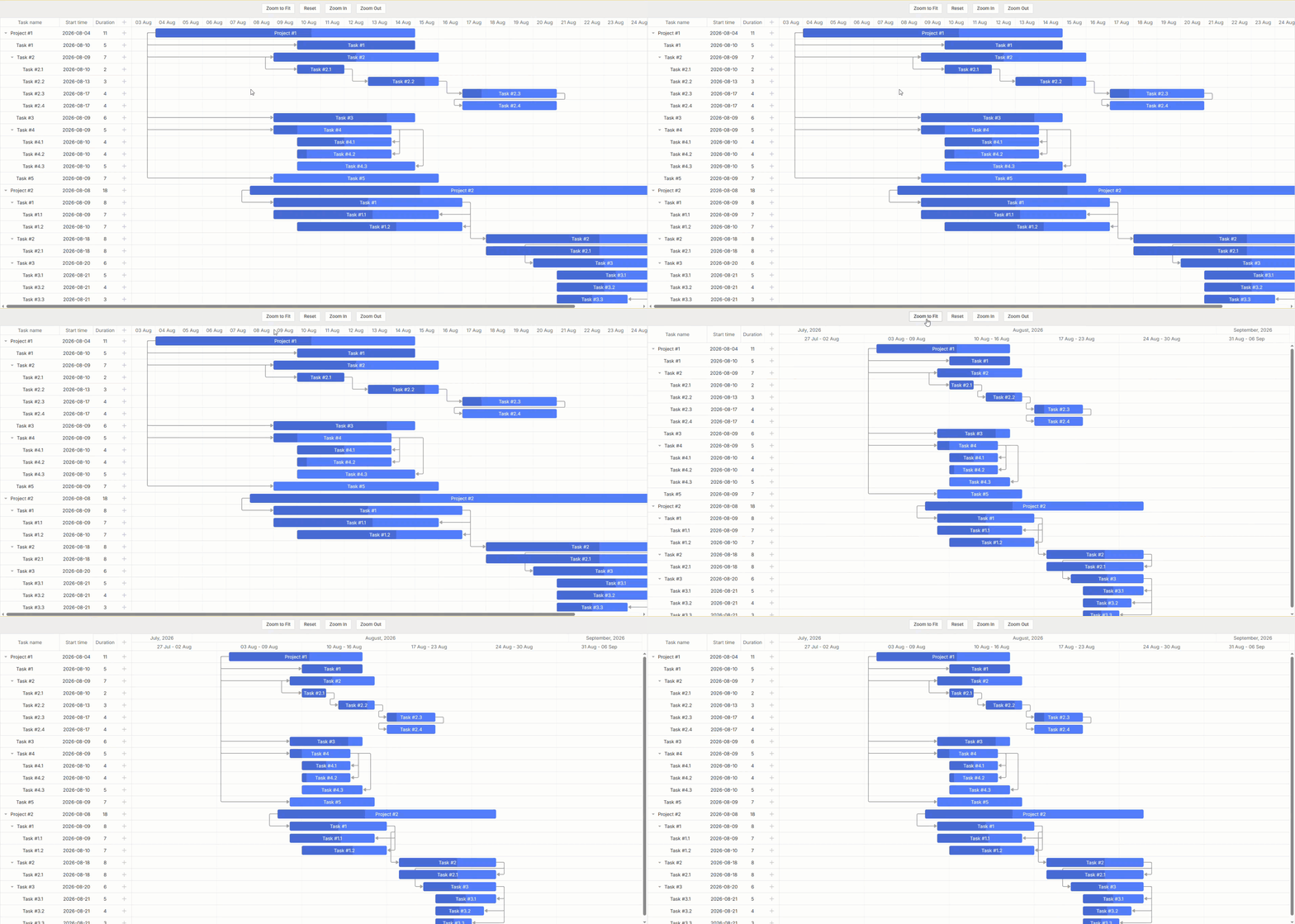
So, instead of endless scrolling and manual zooming to find specific phases of a project, end-users can instantly scale the project timeline to fit into the visible screen area with a single click.
Angular and Vue Wrappers Become Stable
In v10.0, Angular and Vue wrappers for DHTMLX Gantt officially reached a stable status. After a few weeks of testing and refinement in the beta phase, these wrappers now stand alongside the existing React wrapper as production-ready integration options. Technically, this transition also implies standardization of breaking changes in APIs and introduces backward compatibility. Thus, both wrappers offer a reliable, framework-specific way to incorporate a Gantt chart into customer-facing UIs while maintaining direct access to the Gantt API.
Other Improvements
Apart from major changes shipped in v10.0, the release also includes a range of minor enhancements to improve the development experience with the core JavaScript Gantt and wrappers. Here is the list of these novelties:
- React Gantt comes with built-in hooks for popular APIs, and out-of-the-box defaults for the resource histogram, eliminating instance-access boilerplate.
- React Gantt now passes the Gantt instance to customLightbox, enabling direct Gantt API access from the custom editor.
- All three wrappers now enforce secure HTML escaping on template strings by default to reduce the risk of XSS attacks.
- Updated TypeScript typings (more details are provided in the Data Model section)
- The new unified CSP-safe mechanism is used for date parsing and formatting
- The gantt.date interval-start helpers are now pure, returning a new Date object instead of mutating the original.
- The updated localization feature offers additional locales (including new European and Asian languages with their varieties) and translation improvements. The total number of available locales reached 51. Now, these locales come with a complete set of labels.
This concludes the little tweaks and refinements in the Gantt API added in v10.0, but there is also one big announcement we want to make before wrapping up.
Introducing the MIT‑Licensed Community Edition of DHTMLX Gantt
For years, developers have had a great opportunity to integrate Gantt charts in open-source non-commercial project planners, prototypes, or educational projects without paying anything, thanks to the Gantt Standard edition under the GPL license. Now, we are ready to take a big step forward and introduce the new Community Edition of JavaScript Gantt component under the MIT license.
Publishing the Community edition of DHTMLX Gantt under the MIT license further reinforces our commitment to the web development community. The MIT license’s permissive terms will give teams a time-tested, low-friction way to adopt core Gantt functionality across diverse projects, removing licensing constraints.
The Community edition delivers the main Gantt features teams need – project summary tasks and milestones, manual scheduling, multiple dependency types, smart rendering, and a wide range of plugins. The MIT-licensed Community build is functionally comparable to the previous GPL edition. Advanced PRO features (auto-scheduling, critical path analysis, resource planning) continue to be offered under DHTMLX’s commercial licenses. Visit the Community vs PRO Library Versions page to get the full picture of the difference in available features for these editions.
Note: The GPL v2.0 license remains open to public use only for the previous DHTMLX Gantt versions under the Standard edition (before v10.0). To migrate from the GPL version to the Community Edition, follow the instructions.
Over time, we also hope that easier adoption will encourage developers to share their experience with DHTMLX Gantt more openly across GitHub repositories, technical blogs, developer forums, and educational resources. The Community Edition package can be installed via npm by running the following command:
The GitHub repository dedicated to the Community Edition includes other useful instructions on working with the MIT-licensed Gantt component.
While the Community edition lowers the barrier to adopting DHTMLX Gantt, commercial licenses remain the better choice for production-critical projects and organizations that need formal SLAs. Paid DHTMLX licenses deliver not only enterprise-grade PRO features but also professional technical support, timely feature requests and fixes, and robust vendor-backed accountability.
In the “What’s new” section, you can find a quick revision of all the novelties included in DHTMLX Gantt 10.0.
Migration notes present all the information that should be taken into account when switching from earlier Gantt versions to v10.0.
We invite you to download a free 30-day trial version of the commercial Gantt edition to see the renewed scheduling engine and other added features in action. Current customers can access the latest version through their Client’s Area. Those who are new to our Gantt component can start exploring the Gantt capabilities using the Community Edition.