
It feels like this year has flown by, yet it has left noticeable marks on both JavaScript and the whole web development world. We’ve been closely following the shifts across the industry while working hard to evolve the DHTMLX product line in a rapidly changing development environment. As 2025 comes to a close, now is the time to sum up the year’s key developments and look ahead to what 2026 may bring. What are we going to talk about this time? It is not hard to guess that much attention will be focused on AI technologies, the effect of which on both the development process and apps’ functionality simply cannot be ignored.
In this blog post, we’ll consider how AI-first tools continue to reshape long-established development cycles and become common helpers of professional programmers in their daily routines. Then, you’ll learn if traditional frontend technologies stay relevant in this new landscape. Additionally, we’ll highlight the impact of AI on open source and the project management industry.
Let’s get started!
Table of contents:
- AI Shift in Software Development
- Are Top JavaScript UI Frameworks Prepared for the Rise of AI?
- Open-Source Today and Tomorrow: Key Takeaways from GitHub’s Octoverse
- State of Things in Project Management Apps
- Conclusion
AI Shift in Software Development
Just a few years ago, it was hard to imagine that AI would become such a dominant force in software development that some programmers would start genuinely worrying about the future of their careers. AI technologies are growing and evolving at a tremendous pace, reshaping the ways software solutions are built and maintained. This is not a signal for panic, but rather for adaptation to the new reality, as most developers already do.
Generative AI Workflow
Today, probably every professional developer has at least experimented with generative AI, often referred to as traditional AI. Such systems (ChatGPT, Gemini, GitHub Copilot, etc.) help effectively handle various mundane tasks using natural-language prompts (explicit instructions). AI Chatbots are also popular instruments for gathering information on coding issues or development tools.
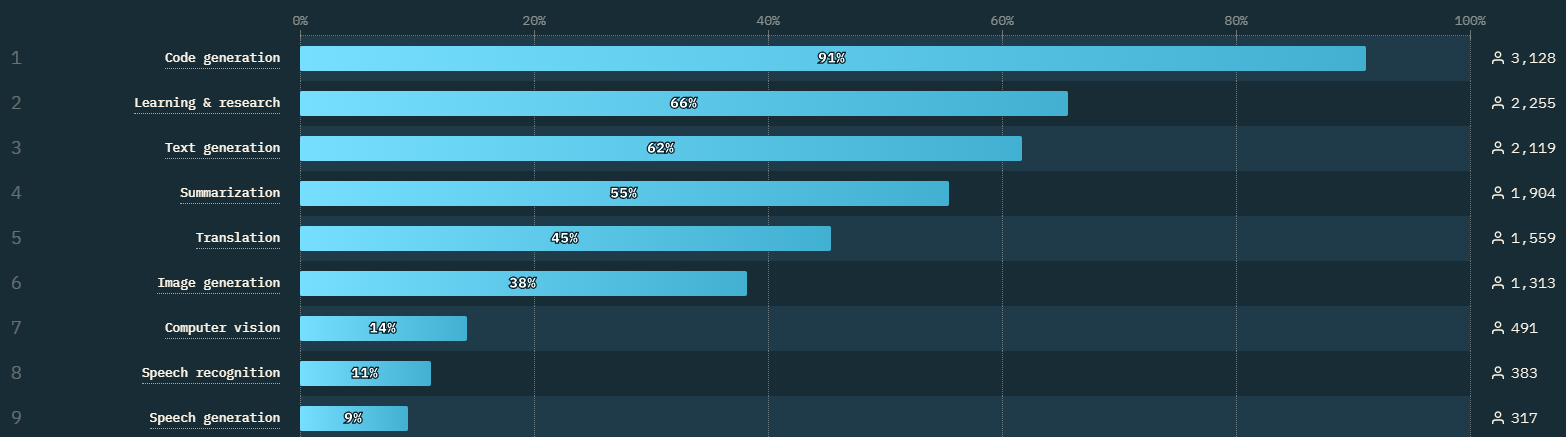 Developers’ use case scenarios for AI (Source: State of Web Dev AI 2025)
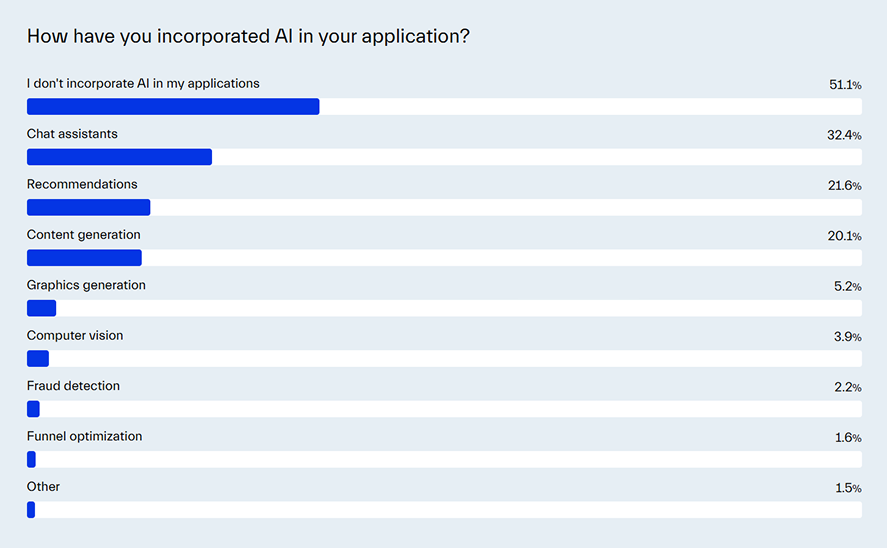
It is also worth noting that AI becomes not just means to an end, but the end itself. Businesses see a great potential in AI, so web applications with AI-powered functionalitieis is no longer a rarity.
 Source: State of Frontend
In general, the respondents of the State of Web Dev AI 2025 were quite positive about the state of AI for web development this year.
 Happiness level with the current AI state in web dev (Source: State of Web Dev AI 2025)
One of the reasons why AI is so attractive to development teams is the huge ecosystem of tools that has emerged to support generative AI workflows:
- Model providers (ChatGPT, Claude, Gemini, Perplexity, Llama, Mistral)
- IDEs and Editors (Cursor, Zed, Windsurf Editor)
- Coding Assistants (GitHub Copilot, Tabnine, JetBrains AI)
- Code Generators (v0, Bolt, Lovable)
However, generative AI is based on a reactive (request-response) approach that allows solving only one specific task at a time within predefined rules and with prompt-aligned output.
Agentic AI Workflow
If that’s the issue, there is already a proactive alternative called agentic AI. It is aimed at independently managing entire workflows and adapting to dynamic conditions. Powered by LLMs, agentic AI systems serve as autonomous workers (agents) capable of handling complex, multi-step processes end-to-end, such as generating significant portions of code, running automated tests, orchestrating CI/CD pipelines, and prototyping.
Here is a basic structure of an agentic workflow:
- Perception (observation) of user input
- Context gathering
- Planning and reasoning
- Execution
- Reflection on results (Feedback)
The agentic workflow combines generative capabilities with independent actions, changing the role of a human from an active participant to an inspector. Thus, dev teams can save significant time and focus on more creativity-demanding tasks or dealing with ambiguous situations. The latest Stack Overflow Developer Survey says that many agent users managed to speed up execution of specific tasks (70%), increase their personal productivity (69%), automate repetitive tasks (64%), and accelerate learning about new technologies and codebases (63%).
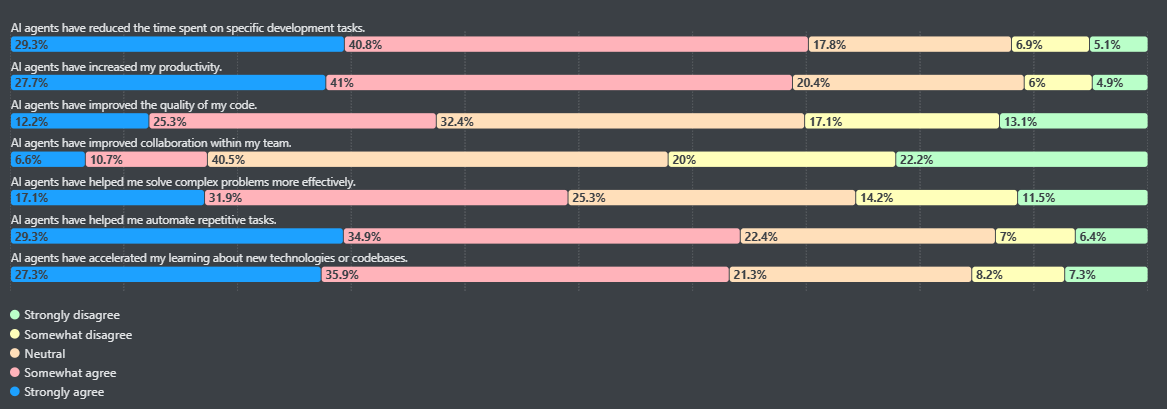 Impacts of AI agents (Source: Stack Overflow Developer Survey 2025)
On the agentic side of AI, developers can make use of such tools as LangChain, LlamaIndex, CrewAI, Semantic Kernel, and AutoGen, which provide the building blocks and abstractions for autonomous, multi-step workflows.
MCP and Vibe Coding
We move on and want to briefly dwell on the growing role of MCP (Model Context Protocol) servers in agentic workflows. Introduced by Anthropic in November 2024, MCP is emerging as a core infrastructure layer that provides a standardized way for LLMs to connect to internal and external capabilities (tools, resources, prompts). Thus, MCP solves key challenges in building practical, scalable, and secure AI agents. According to Anthropic, there are now more than 10,000 active public MCP servers, covering everything from development tools to Fortune 500 deployments. But many companies choose to build their own MCP servers to ensure security, control over data access, and long-term maintainability.
The rapid evolution of AI tools for software development gave rise to another notable trend called vibe coding. It is a new, conversational, iterative way of building apps, where the developer describes the desired product using natural-language prompts, while the LLM writes and refines the code based on the instructions. Despite the mixed attitudes toward it within developer cycles, this approach continues gaining popularity, especially among beginners, non-coders, and enthusiasts, due to its simplicity. Collins Dictionary even named vibe coding the Word of the Year for 2025.
Seems like AI technologies are already capable of playing a key part in real project environments, right? But the Stack Overflow Developer Survey data tells a different story. Most of the interviewed developers distrust the accuracy of AI tools, doubt their ability to handle complex tasks, and are unhappy about spending a lot of time on debugging AI-generated code. AI agents look very promising, but not yet mainstream, and are still raising serious concerns about the learning curve, accuracy, security, and privacy. As for vibe coding, professionals do not show much interest in using this approach for production-level tasks.
All in all, it is not surprising that AI tools are becoming useful for common coding tasks. But human developers still have the final say on the quality and correctness of the output, and it is too early to entrust AI with mission-critical project work.
DHTMLX Opinion on AI-Powered Development
The DHTMLX in-house research on a similar topic showed that effective AI use in development processes requires a balanced approach. Our programmers apply AI tools to handle repetitive work, assist with research, and even help draft code, and in many cases, these tools make life easier. At the same time, we are well aware of current technology limitations. In the code written by most of the DHTMLX programmers, the amount of AI-generated code does not exceed 25%.
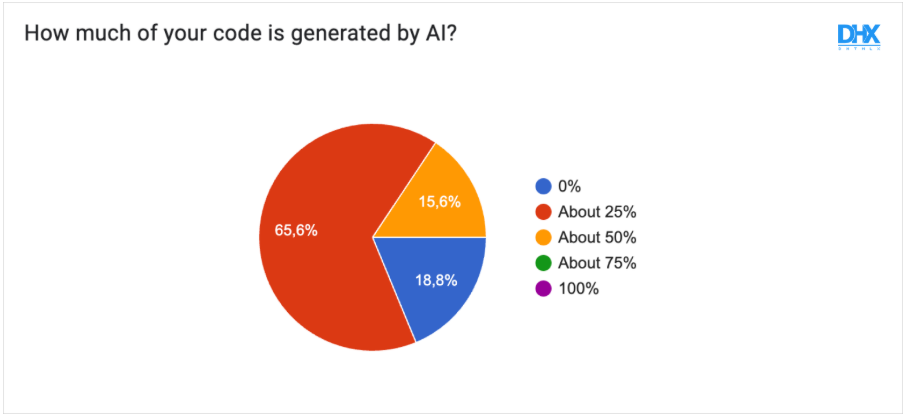 Source: AI in Web Development: Perspective of the DHTMLX Team
AI still often produces errors, hallucinates details, and requires a solid round of human checks. While AI coding assistants are helpful, concepts like vibe coding are viewed as experimental rather than practical. At the moment, the team is convinced that AI can support developers, not replace them. But who knows what comes next, considering how rapidly the AI landscape is evolving. What is clear is that AI is here to remain for the foreseeable future, and we must adapt to its inevitable progress.
Are Top JavaScript UI Frameworks Prepared for the Rise of AI?
We have already found out that developers are showing great interest in AI and are actively exploring AI-driven tools for various web development tasks. In the previous section, we’ve become acquainted with numerous tools specifically designed for AI workflows. What about the traditional frontend frameworks? Are they ready to facilitate the active use of AI in the development lifecycle and the implementation of AI-based features?
The answer is yes. Popular UI frameworks provide developers with a clear path to AI through architectural enhancements rather than native implementations. If you take a look at the updates of recent years, you may notice changes in data handling, rendering, and extensibility. Such adjustments allow frameworks to simplify integration with external AI tools and services without reinventing themselves around AI. Here is what can be said about each framework separately:
| Framework | Adaptation to AI |
| React | React has become a natural fit for AI undertakings thanks to its component-based architecture, efficient rendering, and support for async updates needed for LLM-driven UIs. When paired with Next.js, it also gets native streaming and server-side actions, facilitating real-time AI responses. Therefore, this combination is a solid foundation for building modern AI apps. In addition, React works seamlessly with Vercel’s v0, allowing LLMs to generate React UI code, and with TensorFlow.js for running AI models in web browsers.
Note: do not confuse JS React with a new ReAct (Reasoning and Acting) framework specifically designed to help LLMs solve complex tasks. |
| Angular | Angular provides a stable, structured environment with multiple AI-oriented optimizations. The core architecture includes zoneless change detection and advanced SSR/hydration techniques. The official “Build with AI” guide includes Angular AI Tutor, LLM prompts, AI IDE setup, and design patterns. The recent update (v21) added stable support for the Angular MCP server. |
| Vue | Vue’s lightweight component model and reactivity system make it suitable for AI scenarios. Using its Composition API and reactive primitives, developers can handle dynamic LLM output and complex async flows. To add backend capabilities with SSR, streaming, and server routes, it is possible to combine Vue with Nuxt (with the already available MCP server). |
| Svelte | Svelte is well-known for its simplicity, small bundle size, and high performance, which are favorable criteria for AI-assisted development. Its compile-based approach and reactivity are great for AI interfaces requiring fast updates with minimal overhead. Just like React and Vue, Svelte can be empowered with a meta-framework called SvelteKit for SSR and backend capabilities. Recent Svelte ecosystem additions like MCP and support for the llms.txt convention reflect growing alignment with AI tooling. |
Overall, traditional frontend frameworks remain relevant by providing the architectural patterns and integrations that ensure a smooth AI developer experience. Developers can also benefit from the TypeScript toolkit (AI SDK) from Vercel to facilitate the delivery of AI-powered apps and agents with top web development tools. Moreover, these frameworks have large communities that actively share online their experience and best practices on AI integration via blog posts, tutorials, and video courses.
A similar response to the AI expansion can be observed across the whole frontend landscape. Other tools (IDEs, build systems, runtime environments), commonly included in modern technology stacks, are becoming more AI-friendly. For instance, IDEs come with embedded native AI extensions like AI Toolkit for Visual Studio Code or JetBrains AI Assistant for WebStorm. Build systems (Vite, Webpack) are improving in such aspects as performance, extensibility with plugins, and transparency to meet demands for AI-augmented development practices. As for runtime environments, we want to point out the recent acquisition of the Bun runtime by Anthropic (owner of Claude LLM). This move positions Bun as a core infrastructure layer to power Claude Code, Claude Agent SDK, and future AI coding products and tools. That makes it more interesting to see how this change will affect the Bun’s position in the ongoing competition with Node.js and Deno, which do not ignore the AI trend as well.
DHTMLX Opinion on UI Frameworks and AI
According to our own observations from regular interactions with development teams around the world, it is safe to say that top UI frameworks will remain highly-demanded in web application development in the coming years, and their AI-readiness reinforces our conviction.
This is especially true for React, which has been in the leading positions in rankings of the most used and most desired web frameworks for many years. This is largely explained by the regular introduction of significant innovations (React compiler, Server Components, Actions), high performance, rich ecosystem, and strong community support. Ready-made commercial and open-source React UI components (e.g., SVAR React Component Library) are popular among development teams who are looking for ways to enhance their productivity.
It’s no surprise that in past years, one of the most popular requests from our clients was the ability to use our UI components in the React environment. Our regularly updated collection of integration demos for React and other frameworks helps address this need. But this year, we took another step forward in this direction and rolled out Gantt and Scheduler solutions specifically for React enterprise-grade apps.
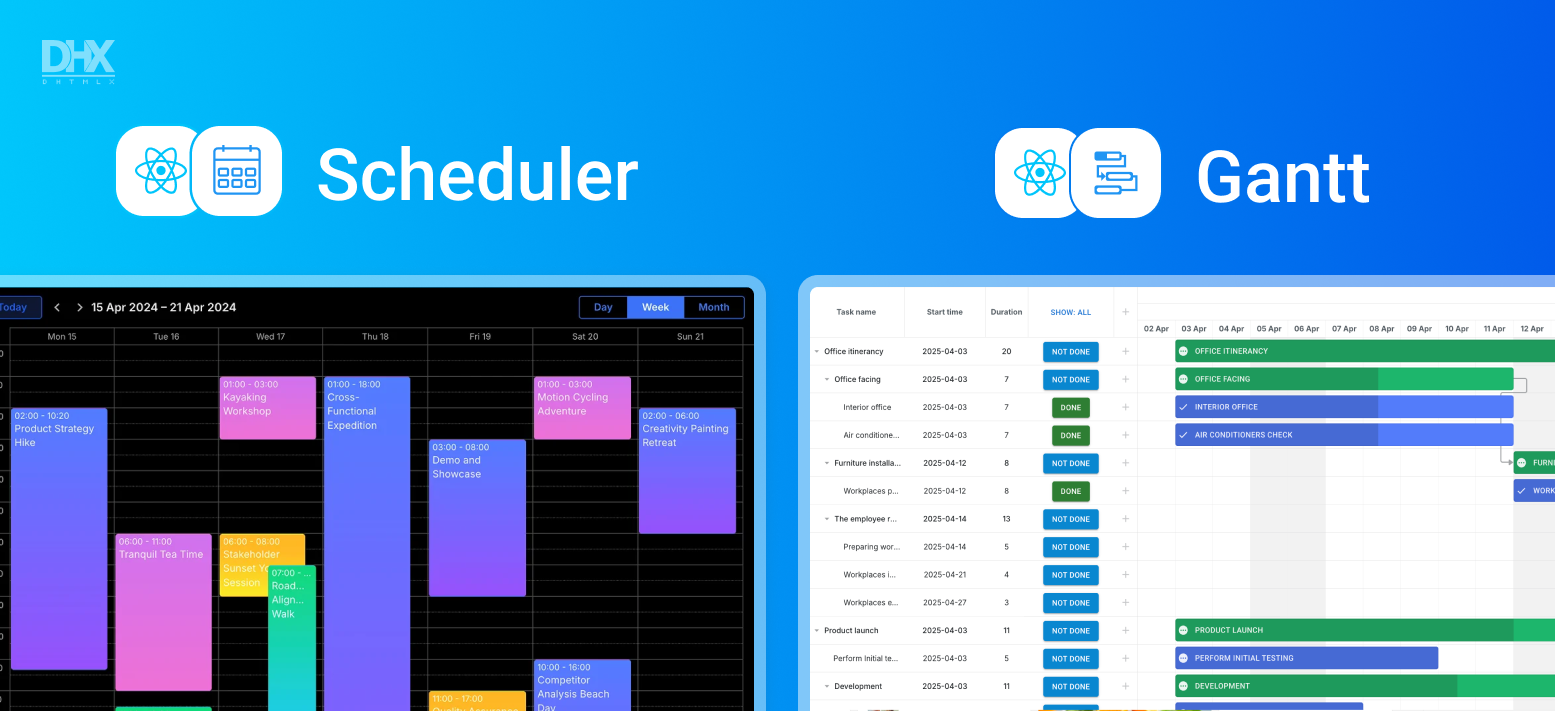
The React Gantt chart library is a powerful tool for effective workflow management, while the React scheduler component covers all scheduling needs. What to expect from these novelties? These tools adopt advanced functional capabilities of our well-known Gantt and Scheduler components via their APIs and simplify the integration process by aligning with core React principles and lifecycle. Both components are highly customizable and compatible with popular technologies from the React ecosystem, such as Redux, MUI, Next.js, and Remix. We also plan to start working on similar native components for other frontend frameworks.
As providers of another category of tools for building web apps, namely JavaScript UI components and widgets, we are also making efforts to adapt DHTMLX products to AI workflows. Our team actively experiments with integrating AI capabilities into our JavaScript components and explores other ways to bring the power of AI to DHTMLX users. The most recent and notable move in this direction is the DHTMLX MCP server, designed to maximize the efficiency of using our major products with popular AI coding environments such as Claude Code, Cursor, or Antigravity. And there is much more to come in 2026.
Open-Source Today and Tomorrow: Key Takeaways from GitHub’s Octoverse
GitHub is rightfully considered a vivid indicator of trends in software development. Today, the platform plays a vital role in open-source development, where many innovations are born. Here, hundreds of thousands of developers from all over the world find a favorable environment for collaborative testing, refining, and scaling of breakthrough technologies, influencing standards and commercial products. What has been agitating the minds of the members of the largest and fastest-growing open-source platform in 2025?
If you take a look at the trending section on GitHub, it is easy to see that AI-related projects are in the groove. Let us elaborate on the subject using curious findings from the latest GitHub’s Octoverse survey.
AI Becomes a Part of Everyday Workflow
In commercial projects, the use of AI is often hampered by the current imperfections of the technology and the associated risks. The open-source environment, on the contrary, readily embraces AI as a part of ordinary engineering, which is confirmed by staggering numbers published in Octoverse 2025.
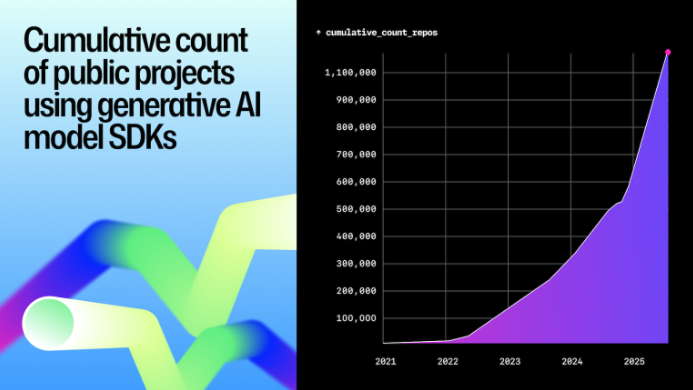
For instance, 80% of GitHub newcomers used GitHub Copilot during the first week of their activity on the platform, indicating the deep integration of AI into everyday programming practices and a change in standard workflows. Also, it is said that half of the open source projects on GitHub have at least one maintainer using the Copilot coding assistant. Compared to the last year, there is a high growth rate in projects depending on generative AI SDKs (+178%), monthly distinct contributions to AI repos (+111%), and monthly commits/contributions to AI projects (+188%).
 Source: Octoverse 2025
The overall number of GitHub repositories related to AI now exceeds 4.3 million, nearly doubling in less than two years.
Open Source AI Infrastructure is Gaining Momentum
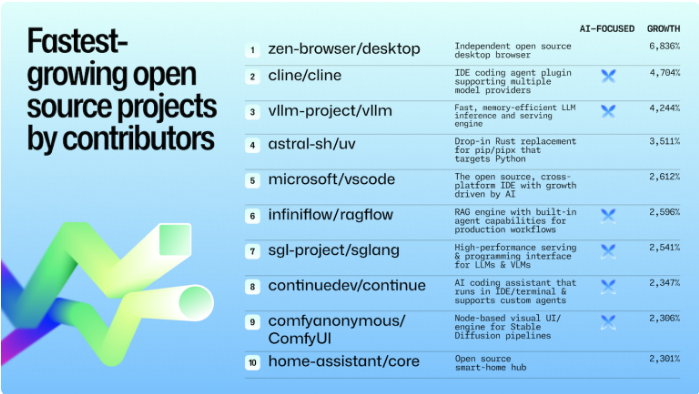
Building and deploying complex AI systems efficiently certainly demands a solid AI infrastructure. So this year, the GitHub community also put forth a great effort into AI runtimes, orchestration frameworks, and efficiency tools. As a result, 6 of the 10 fastest-growing repositories on GitHub in 2025 were AI infrastructure projects.
 Source: Octoverse 2025
The list of the top open source projects by contributors also includes other popular AI infrastructure solutions such as ollama, huggingface/transformers, and llama.cpp. Generally, these tools are used for local LLM deployments, contributing to enhanced security and confidentiality. Thus, contributors are seriously involved in the formation of the foundation layers for AI.
TypeScript is the Most Popular Language on GitHub
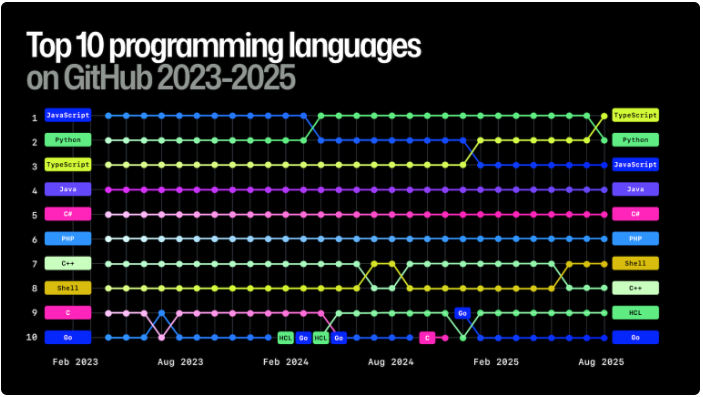
Last year, Python interrupted the long-term hegemony of JavaScript in the ranking of the most used programming languages on GitHub. Here is a new twist in 2025 – TypeScript is now on top. According to the survey, more than a million developers contributed to TypeScript in 2025, which is a 66% increase compared to the previous year.
Source: Octoverse 2025
This TypeScript’s success is strongly tied to the fact that its static type system is perfectly suited for AI. Here is how:
- Error prevention. The typed system helps identify LLM-generated compile errors earlier in the pipeline.
- Better context for AI. Type annotations reduce ambiguity and provide more accurate and relevant code suggestions than dynamically typed languages.
- Convenient validation of AI output. Static typing makes it easier for developers to review the AI-generated code.
- Deep integration. TypeScript integrates well with top UI frameworks, runtime environments, SDKs, and increasingly, with AI-driven tools.
Developers are moving toward typed languages that make AI-assisted coding more reliable and maintainable. At the same time, TypeScript currently lags behind Python and JavaScript in the number of AI-tagged repositories and the total number of projects on GitHub.
DHTMLX Opinion on How AI Impacts Open Source
The fast adoption pace of AI tools and infrastructure on GitHub suggests that this trend is far from slowing down. As Octoverse insights show, AI is already influencing not only coding practices but also decisions around preferred programming languages and tooling. It is reasonable to expect that similar changes will affect commercial software development next. Therefore, it is a clear signal for software vendors to prepare now rather than react later.
We at DHTMLX never miss the opportunity to share various useful materials related to DHTMLX products, including integration examples with UI frameworks and backend technologies, demo apps, and proof-of-concept projects. These resources demonstrate best practices of using DHTMLX JavaScript UI components in various scenarios and lower the adoption barrier for developers. In recent months, our team rolled out 5 AI-driven demo projects:
- AI Gantt Maker
- AI Gantt Theme Builder
- AI Org Chart Builder
- AI-Powered Review Analysis
- AI Form Builder
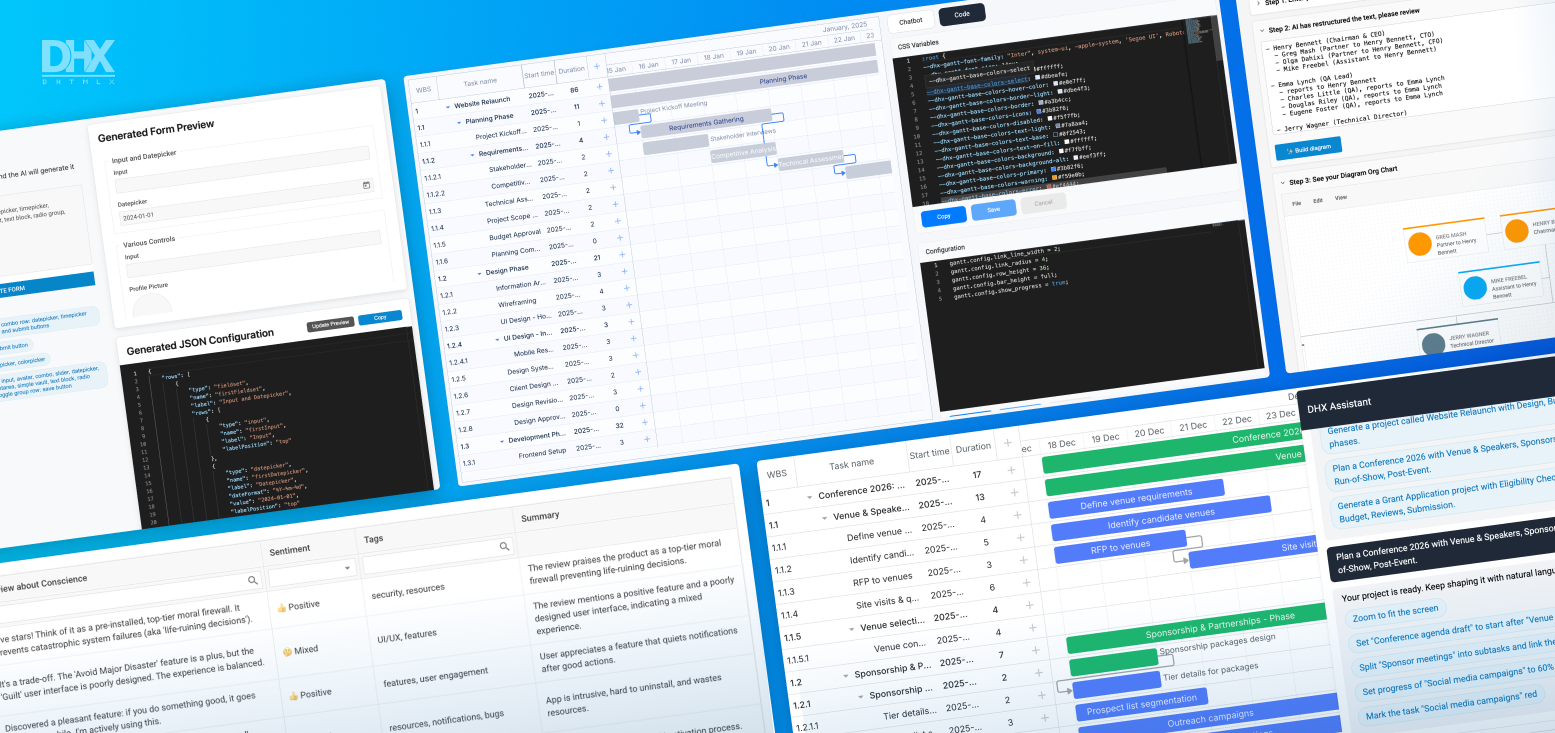
These projects vividly demonstrate how to connect popular DHTMLX UI components to various AI models, allowing complex UI manipulations to be expressed in natural language prompts. We plan to continue active work in this and other AI-related directions.
State of Things in Project Management Apps
DHTMLX provides high-quality JavaScript UI components for implementing advanced functionality across a wide range of business application domains. But project management remains the main area of our expertise. Therefore, the final section of our survey is dedicated to software development for the industry and the impact of AI on it.
As modern projects are becoming increasingly complex with larger teams, intricate processes, and information overloads, many project managers feel enthusiastic about AI-enabled optimizations. For instance, AI-driven tools prove to be effective in analyzing vast datasets, automating repetitive tasks, balancing workloads, and optimizing task assignments. Large companies like Amazon, Autodesk, and JPMorgan Chase already delegate some parts of their working processes to AI solutions, and it pays off.
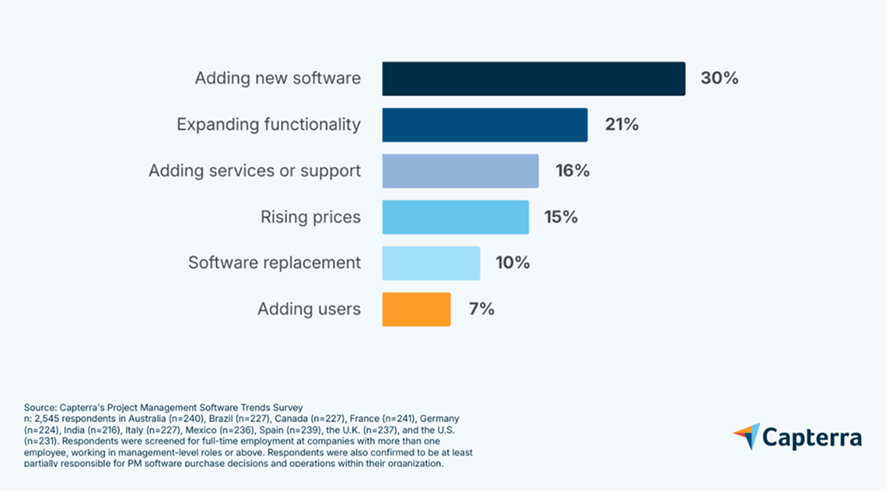
Capterra’s latest global survey on project management trends says that businesses increase spending on project management software for a number of reasons shown below.
 Source: Capterra
More than half of survey respondents (55%) cited the possibility of using AI to tackle project challenges as the primary reason for their most recent PM software purchases. At the same time, there are valid concerns that some teams lack the skills to utilize AI features effectively and that they may be incompatible with existing workflows.
Despite all the buzz and hype around AI, traditional project management features do not lose their relevance. According to Capterra’s user ratings data, teams point out the importance of some key project management features:
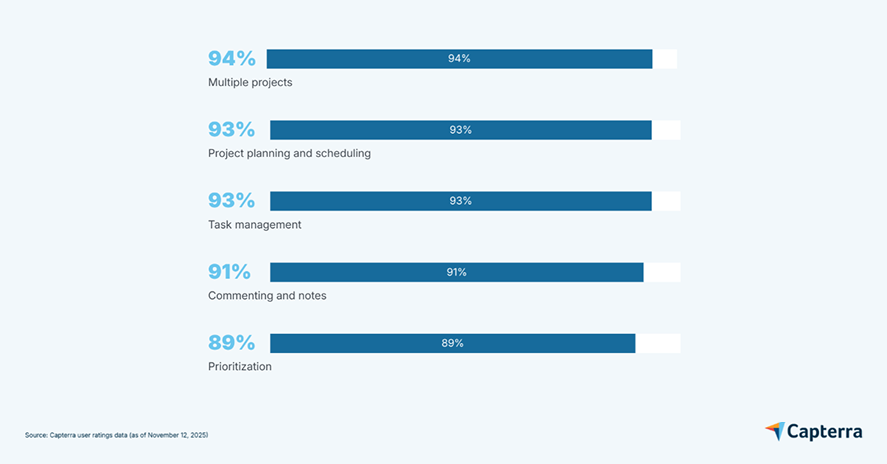
Source: Capterra
These are comprehensive functionalities embedded in popular PM instruments (Gantt charts, scheduling calendars, Kanban boards, etc.), but it is not always easy to cover specific project management needs with ready-made PM solutions. That is why the demand for UI components that speed up the development of custom PM tools remains strong.
DHTMLX Opinion on Continued Demand for Custom PM Tools
For the present, AI can already assist with many project management tasks. However, it is still a helpful addition layered on top of time-proven PM tools rather than a foundation of project execution. Custom project management apps continue attracting significant investments, and development teams often choose our UI components to make things easier. But it does not mean that we can get complacent.
Apart from the already mentioned React Gantt and React Scheduler, this year our team released updates for DHTMLX JavaScript Gantt, Kanban, To Do List, and Booking components. We should also mention the availability of a new project visualization option, namely PERT Chart (mode in DHTMLX Diagram), which is easily combined with JS Gantt for vivid workflow presentations.
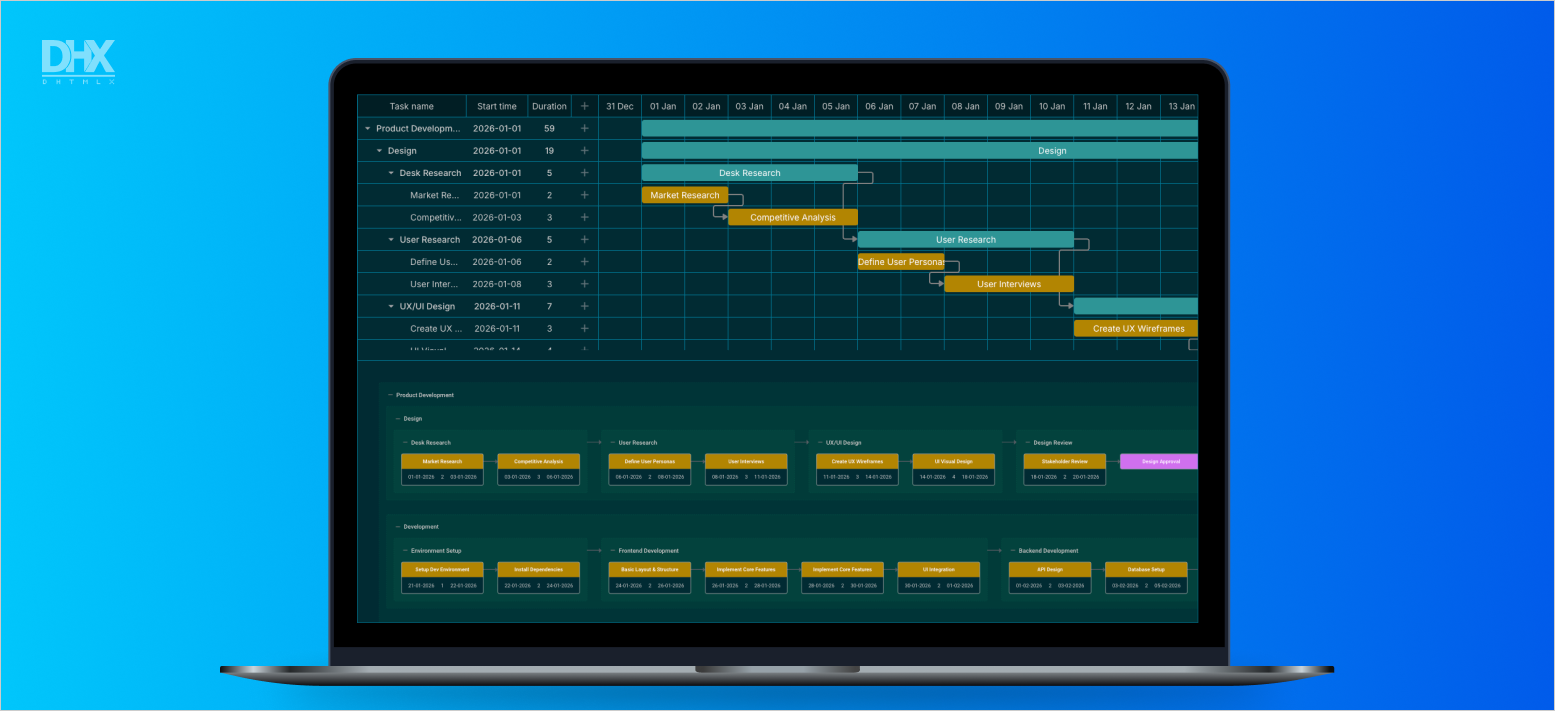
Lastly, we would like to highlight our efforts in expanding developers’ capabilities in creating effective tools for data analysis, where AI starts to flourish as well. In 2025, we enriched DHTMLX Grid with numerous new features for data handling, such as row expander, multisorting, history management, and Excel-like interactions. For displaying and manipulating data at a higher level, we also updated DHTMLX Spreadsheet and Pivot components. For those whose priority is content management, here is DHTMLX Rich Text Editor with reworked architecture, better performance, and many new features.
Conclusion
Looking ahead to 2026, it is clear that AI is no longer an experimental add-on but an increasingly important part of the IT industry. AI-powered solutions have a growing influence on development workflows, open-source collaboration, and even investment in commercial tools. But despite its impressive progress in various aspects of application development, AI still needs a solid foundation to build upon (typed languages, traditional frameworks, IDEs, UI components, etc.) and human control. There is little doubt that AI will continue evolving in 2026, but its practical value will be defined by how thoughtfully teams use AI in real-world scenarios.
In the coming year, our team will focus on improving our product line, supporting our users, and creating optimal conditions for using AI with DHTMLX.