
Modern business workflows become more complex and require careful coordination. Therefore, many companies face the need to visualize and standardize their workflows online. Similar requests were sent to the TICGAL, company specialized in IT services for the open-source GLPI platform. To achieve this goal, they chose DHTMLX Kanban. Today, we meet Oscar Beiro from TICGAL, who’ll share the details of working with our JavaScript Kanban component.
Hello, Oscar! Could you tell us about your project and your role in it?
My name is Oscar Beiro, and I represent a small company named TICGAL based in Galicia in the northwest of Spain. We offer a 360 service around the tool called GLPI. It is an open-source tool that covers key areas such as service desk and asset management. The main competitors of GLPI are Jira, ServiceNow, Ivanti, and Freshdesk, all of which also offer ticketing solutions. GLPI is developed by a French company called Teclib. We are Teclib’ partners and, among others, we provide development services around GLPI. We develop plugins and integrations for both the official marketplace and what we call Xtended Plugins offered through our own e-shop. We have approximately 12 published open-source plugins, and more than 75 extended ones. Last year, we got requests from a few customers to build more complex solutions. That’s where your Kanban component came into play.
We decided to keep going open source, but we don’t share our developments publicly. We charge a small fee to maintain plugins and make it all profitable for us. These are the Xtended Plugins.
Do you have clients worldwide, or focus only on the national market?
We are a small company, but we have clients from 30 countries on five continents. Although most of our clients are in Spain, we have big clients in Africa and other parts of the world. There are several levels of partnership with Teclib (silver, gold, platinum), and we have the platinum partnership tier. There are only five companies with such status, and we are the only one not located in France.
What is the main purpose of DHTMLX Kanban in your project?
We received a specific request to enhance the native Kanban tool for GLPI. So we started exploring various libraries and open-source tools to deliver this functionality, but we didn’t find anything suitable. What helped us was the fact that GLPI had already been using your Gantt library, which worked pretty well. We discovered that your product line also includes
the Kanban component. So, we shared this option with our clients, and it worked out well. We call it Agile Project Management for GLPI.
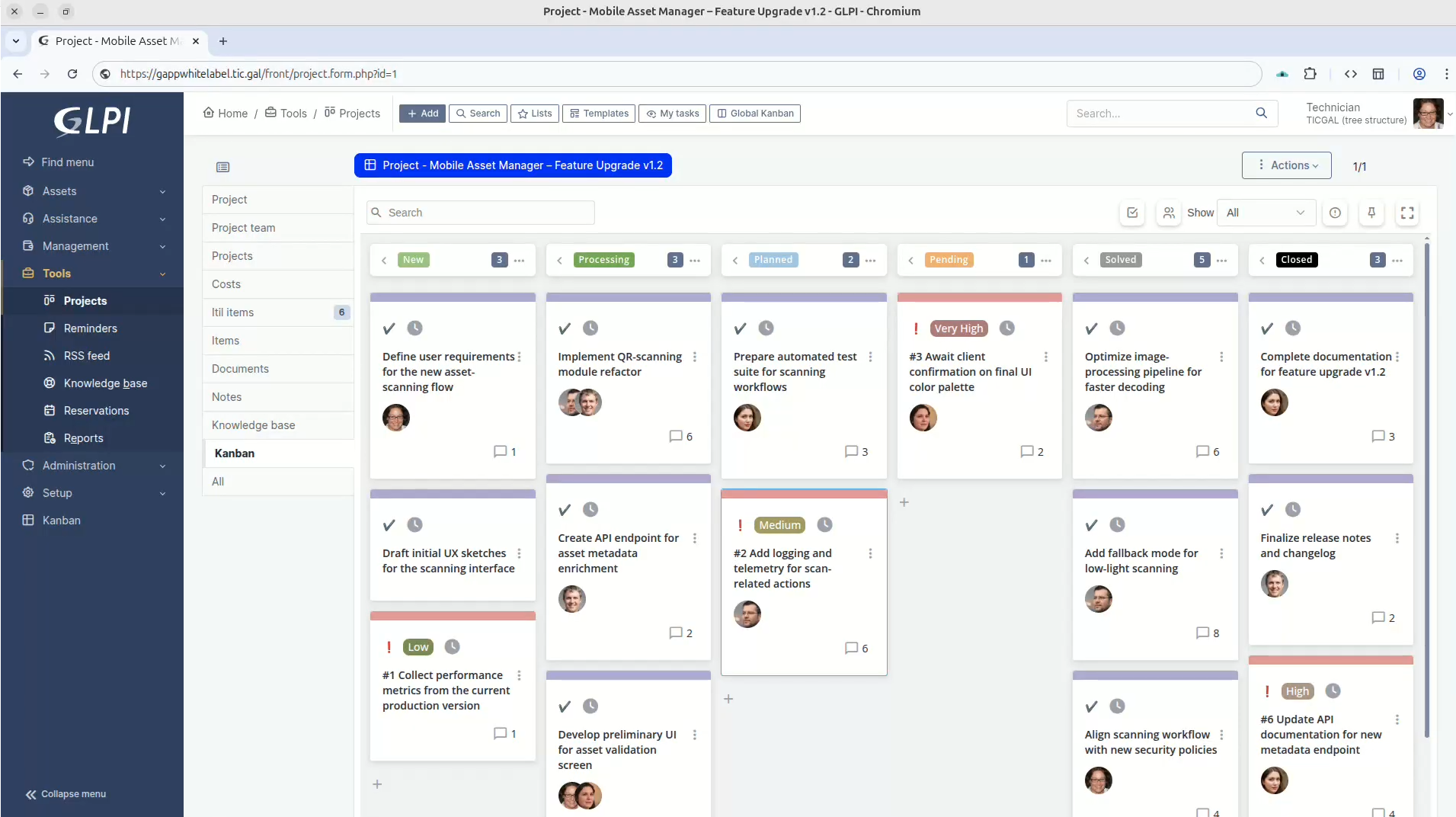
In the end, our customers want to manage projects, but they have different approaches. We want to develop several project management approaches. For instance, we are beginning with a Kanban Ticket custom model, but SCRUM is on the way, and a pure Kanban is under study. We may also offer any other methodologies tailored to your specific project demands.
Why did you choose DHTMLX Kanban over other available options?
Since the DHTMLX Gantt component had already been successfully integrated into GLPI, we knew what to expect from your product, which helped us speed up the integration.
What are the most useful features of our Kanban for your project?
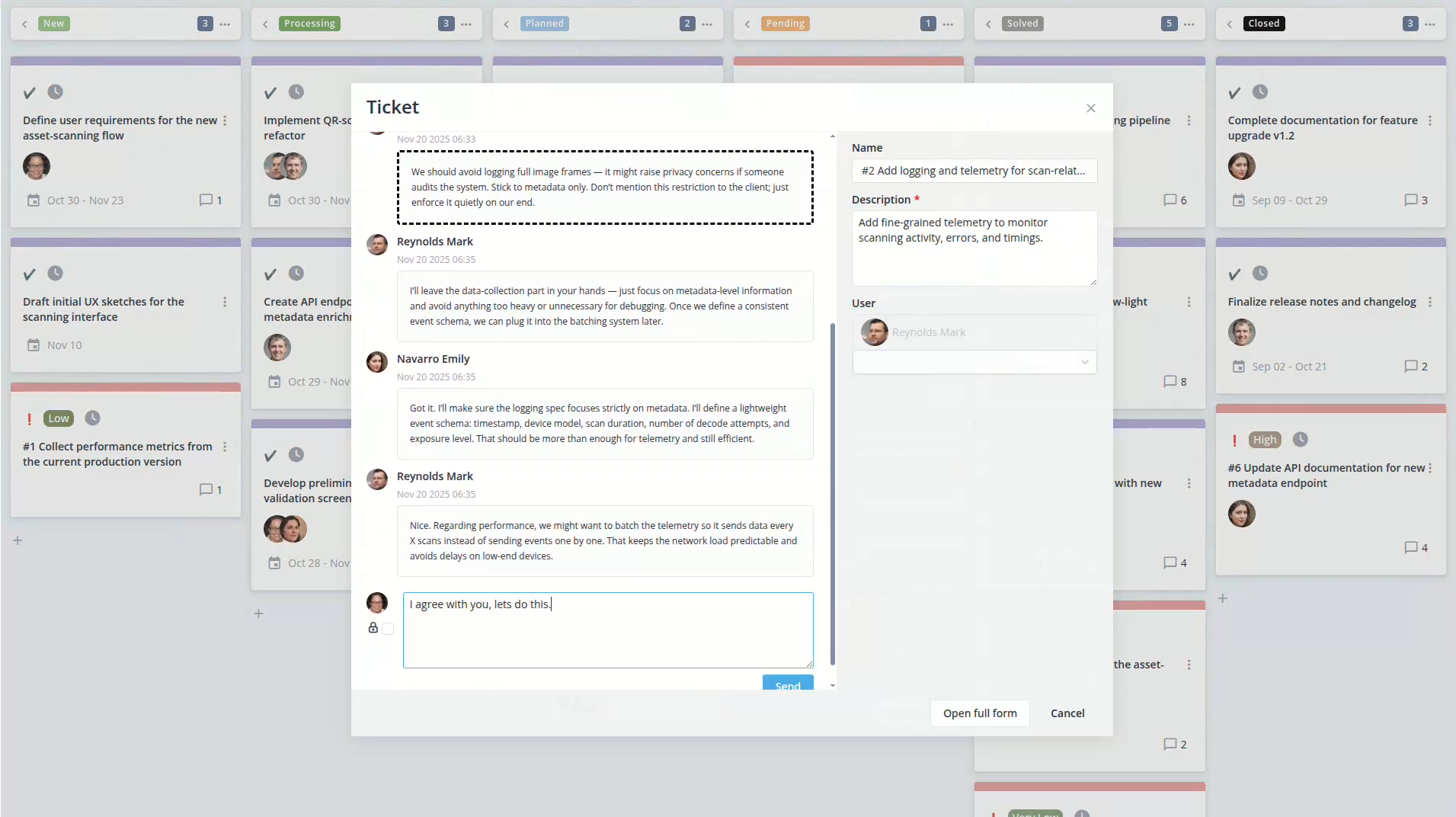
The main thing is that DHTMLX Kanban provides many useful features out of the box. Your live samples vividly demonstrate how to implement everything we needed, including task labels, duration, assignments, comments, etc. Therefore, it was easy for us to reuse what your component already had, so we didn’t need to reinvent the wheel here. Your solutions also look nice in terms of design, which is great for us. As a result, we have a convenient tool for task management within a project.
Did you experience any difficulties when implementing DHTMLX Kanban?
We had a problem with the full-screen mode, like in your Gantt. But your team helped us to solve this issue.
Which frontend and backend technologies do you use together with our Kanban component?
We align with the GLPI Stack. The backend utilises PHP to manage business logic and database persistence (MySQL).
For the frontend, Twig renders the application structure and injects the initial state. Vanilla JavaScript handles the interactivity and custom logic for components such as the DHTMLx Kanban board.
Thank you very much for sharing your story and experience with DHTMLX Kanban. We wish your company success and new achievements in the future.
Our Customer Success Stories page provides more real-world scenarios of using DHTMLX UI components.